
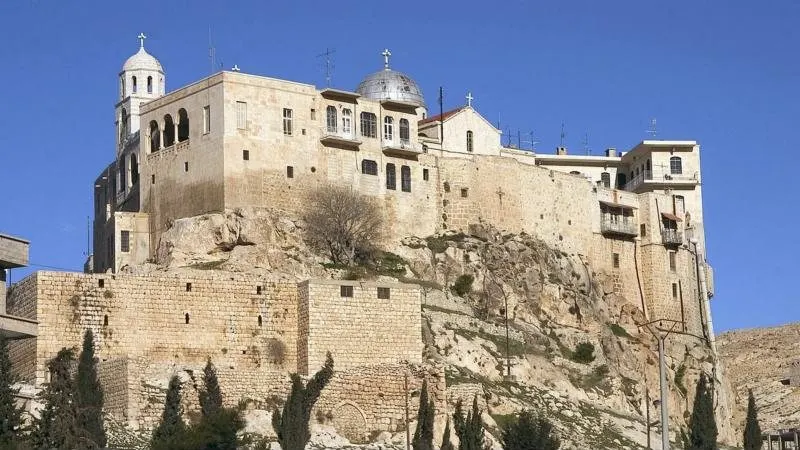
A Mountain Monastery in the Heart of Qalamoun
High above the rugged landscapes of Syria’s Qalamoun Mountains, near the town of Nebek, stands Mar Musa, one of the country’s most extraordinary spiritual landmarks. Carved into dramatic desert cliffs and overlooking vast valleys, this ancient monastery offers not only breathtaking views but also a profound encounter with history, faith, and coexistence.
For centuries, pilgrims, monks, and travelers have climbed the stone steps leading to Mar Musa, drawn by its serene beauty and powerful spiritual presence. Its remote location enhances its mystique, creating a sense of retreat from the modern world and an invitation into contemplation.
Origins Rooted in the 6th Century
The story of Mar Musa begins in the 6th century, when Saint Moses the Abyssinian, known in Arabic as Mar Musa al-Habashi, established a humble hermitage on this mountain slope. What started as a solitary refuge gradually evolved into a flourishing monastic center.
Over time, Mar Musa became renowned for Christian spirituality and learning. Monks from across the region sought its silence for prayer and study, while pilgrims visited to experience its sacred atmosphere. The monastery’s endurance across centuries reflects the deep-rooted spiritual traditions that have shaped Syria’s cultural heritage.
Architectural Harmony and Sacred Art
One of the most captivating aspects of Mar Musa is its architectural simplicity blended with artistic richness. Built in harmony with the natural rock formations, the complex includes a church, chapels, monastic cells, and communal spaces that seem to grow organically from the mountain itself.
Inside the church, visitors encounter extraordinary frescoes dating from the 11th and 12th centuries. These paintings depict biblical scenes, saints, and symbolic imagery influenced by Byzantine and local artistic traditions. The frescoes of Mar Musa are among the most significant examples of medieval Christian art in Syria, preserving vibrant colors and intricate details despite the passage of time.
The intimate scale of the church enhances its spiritual power. Candlelight reflects on ancient walls, and the silence carries echoes of centuries of devotion.
Decline and Rediscovery
Like many historic monuments, Mar Musa experienced a period of decline in the early 20th century and was eventually abandoned. For decades, the monastery stood in silence, exposed to the harsh mountain climate and the erosion of time.
Its remarkable revival began in the 1980s with the arrival of Italian Jesuit priest Father Paolo Dall’Oglio. Inspired by the site’s spiritual depth, he initiated restoration efforts that transformed the ruins into a living monastic community once again. Through dedication and vision, Mar Musa regained its role as a spiritual beacon in the region.
A Bridge Between Faiths
What truly distinguishes Mar Musa is its pioneering commitment to interfaith dialogue. Under Father Paolo’s leadership, the monastery opened its doors not only to Christians but also to Muslims and people of diverse beliefs.
In a region often marked by division, Mar Musa became a space for conversation, hospitality, and mutual respect. Shared meals, discussions, and moments of prayer fostered understanding between communities. The monastery’s mission emphasized compassion, justice, and peaceful coexistence: values deeply embedded in both Islamic and Christian traditions.
This spirit of openness elevated Mar Musa from a historic site to a living symbol of unity.
Humanitarian Commitment and Community Support
Beyond spiritual dialogue, Mar Musa became known for its humanitarian outreach. The monastic community supported local families, encouraged education, and provided assistance during times of hardship.
The monastery’s work demonstrated how faith-based institutions can serve society in practical and transformative ways. Even after Father Paolo’s disappearance in 2013, a painful and unresolved chapter in the monastery’s history, the community of Mar Musa continued its mission with resilience and determination.
A Journey of Reflection and Renewal
Visiting Mar Musa is more than a cultural excursion; it is a deeply personal experience. The ascent to the monastery becomes symbolic: a gradual leaving behind of noise and distraction.
Within its ancient walls, visitors discover a tranquil environment that invites reflection. The sweeping desert panorama, the crisp mountain air, and the sacred art combine to create a sense of timelessness. Many travelers describe their time at Mar Musa as transformative, offering clarity, inspiration, and inner peace.
Whether motivated by faith, history, or curiosity, those who climb to Mar Musa often leave with a renewed sense of perspective.
Cultural Significance in Modern Syria
In the broader narrative of Syria’s diverse heritage, Mar Musa holds a unique place. It represents centuries of Christian tradition while embodying modern ideals of coexistence and dialogue.
The monastery stands as a reminder that Syria has long been a crossroads of civilizations and religions. Its endurance through periods of conflict and uncertainty reflects the resilience of cultural and spiritual heritage.
Today, Mar Musa continues to welcome visitors seeking meaning and connection. Its story intertwines faith, art, history, and humanitarian service into a powerful testament of hope.
An Enduring Legacy of Faith and Unity
The legacy of Mar Musa extends far beyond its mountain walls. It symbolizes the possibility of harmony between traditions and the transformative power of spiritual spaces.
As the sun sets over the Qalamoun Mountains and light fades across the desert horizon, the monastery remains a quiet yet powerful presence. In its stones and frescoes, in its silence and dialogue, Mar Musa continues to inspire all who make the journey upward, inviting them to rediscover the enduring values of peace, resilience, and shared humanity.